One misread can cost you thousands of dollars. When a lender says your rate dropped by “25 points,” do they mean 25 basis points (0.25%) or 25 percentage points (a massive 25.00% change)? These two terms are used daily in finance, yet they are constantly confused — even by experienced borrowers.
This guide breaks down the exact difference between basis points and percentage points, shows you how to convert between them, and explains why finance professionals prefer one over the other.
What Is a Basis Point?
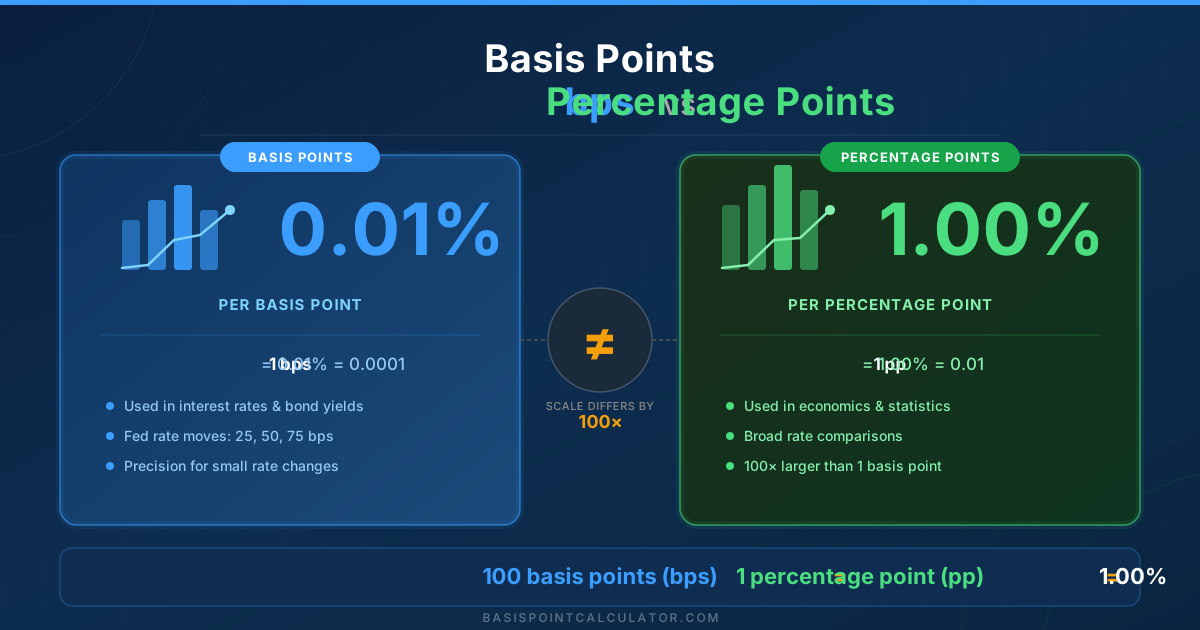
A basis point (bps) is equal to one one-hundredth of a percentage point:
1 basis point = 0.01% = 0.0001 (decimal)
So 100 basis points equals exactly 1 percentage point.
Basis points are used whenever precision matters in small rate movements — interest rates, bond yields, loan spreads, and central bank decisions. Instead of saying a rate moved from 5.00% to 5.25%, finance professionals say it moved “25 basis points.” This removes any ambiguity about whether the change was relative or absolute.
Common basis point values:
| Basis Points (bps) | Percentage (%) | Decimal |
|---|---|---|
| 1 bps | 0.01% | 0.0001 |
| 10 bps | 0.10% | 0.001 |
| 25 bps | 0.25% | 0.0025 |
| 50 bps | 0.50% | 0.005 |
| 75 bps | 0.75% | 0.0075 |
| 100 bps | 1.00% | 0.01 |
| 200 bps | 2.00% | 0.02 |
What Is a Percentage Point?
A percentage point (pp) is a straightforward unit expressing the arithmetic difference between two percentages.
1 percentage point = a change of 1.00% in absolute terms
If your mortgage rate goes from 6.00% to 7.00%, that is a change of 1 percentage point — or equivalently, 100 basis points.
Percentage points describe absolute changes in percentage values and are commonly used in economics, statistics, and everyday reporting (e.g., “unemployment fell by 0.5 percentage points”).
The Critical Difference: Side-by-Side Comparison
This is where most confusion occurs. The key distinction comes down to scale:
| Basis Point (bps) | Percentage Point (pp) | |
|---|---|---|
| Size | 0.01% | 1.00% |
| Relationship | 1 bps = 0.01 pp | 1 pp = 100 bps |
| Used in | Interest rates, bonds, Fed decisions, loan spreads | Economics, statistics, broad rate comparisons |
| Precision | High — ideal for small changes | Low — best for larger changes |
| Example | Rate moved 25 bps = up 0.25% | Rate moved 1 pp = up 1.00% |
The fast rule to remember:
To convert basis points → percentage points: divide by 100 To convert percentage points → basis points: multiply by 100
Real-World Examples
In Mortgage Rates
Suppose your lender offers you a rate of 6.50% on a 30-year, $300,000 mortgage. You negotiate, and they agree to drop the rate by 50 basis points.
- New rate: 6.50% − 0.50% = 6.00%
- Monthly payment at 6.50%: ~$1,896
- Monthly payment at 6.00%: ~$1,799
- Monthly savings: ~$97 | Annual savings: ~$1,164
If someone had mistakenly said “50 percentage points,” that would imply dropping from 6.50% to −43.50% — an impossible rate. This is exactly why basis points exist: to make small, precise changes unambiguous.
In Federal Reserve Rate Decisions
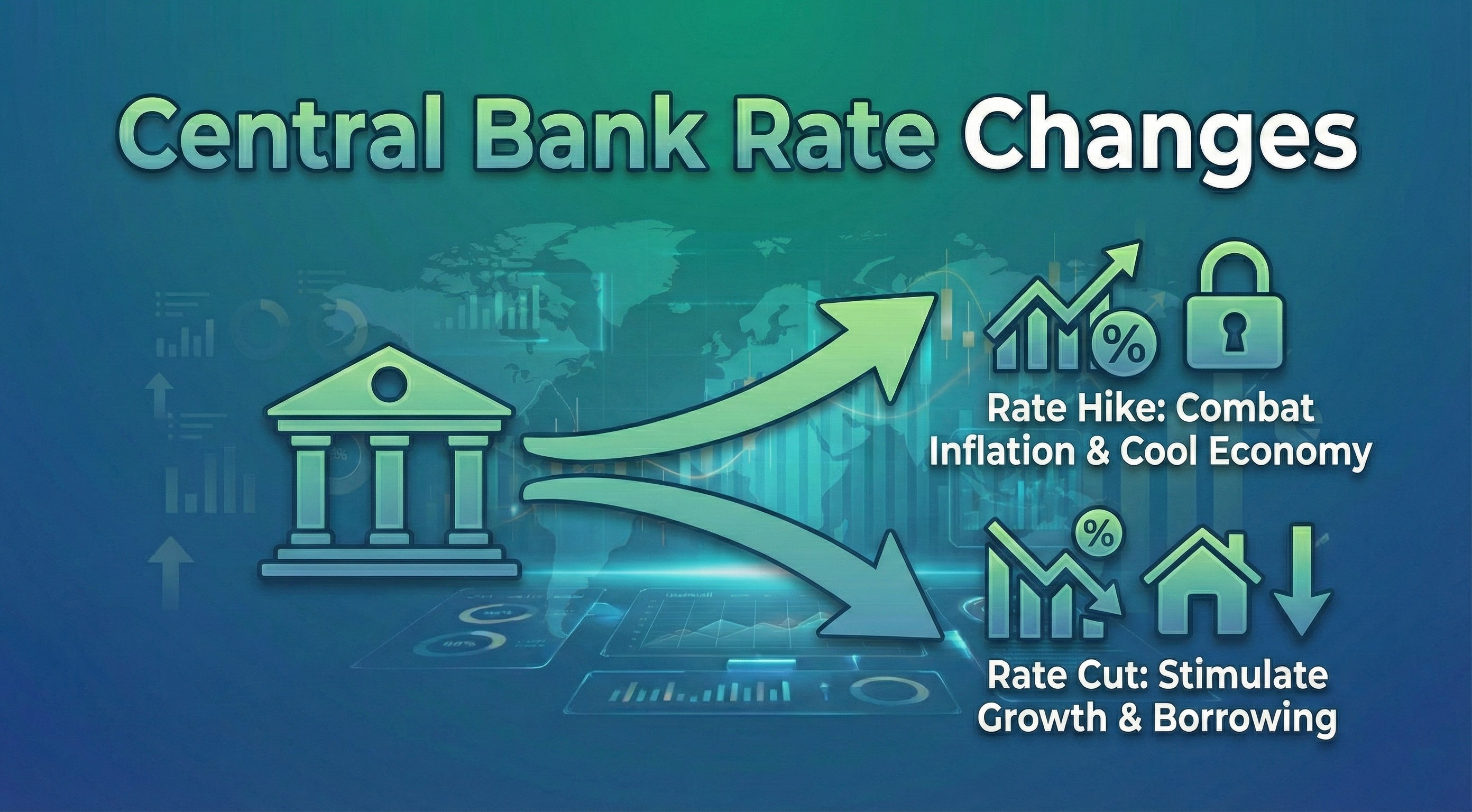
When the Federal Reserve announces a rate hike, they always speak in basis points:
- 25 bps hike = rates go up by 0.25% (a standard small move)
- 50 bps hike = rates go up by 0.50% (a moderate move)
- 75 bps hike = rates go up by 0.75% (an aggressive move, last seen in 2022)
A “25 percentage point hike” would be catastrophic and economically impossible. The precision of basis points makes central bank communication clear and unambiguous.
In Investment Returns
An investment fund that charges 75 bps in annual fees charges 0.75% per year on your balance.
- $100,000 portfolio × 0.75% = $750/year in fees
If that fund lowered fees by 20 bps (to 55 bps = 0.55%), your annual fee becomes $550 — a savings of $200 per year. Describing this as “0.2 percentage points” conveys the same information, but “20 basis points” is the industry standard for this level of precision.
How to Convert Between Basis Points and Percentage Points
Basis Points → Percentage Points
Percentage Points = Basis Points ÷ 100
| Basis Points | Percentage Points |
|---|---|
| 5 bps | 0.05 pp |
| 25 bps | 0.25 pp |
| 50 bps | 0.50 pp |
| 100 bps | 1.00 pp |
| 150 bps | 1.50 pp |
| 300 bps | 3.00 pp |
Percentage Points → Basis Points
Basis Points = Percentage Points × 100
| Percentage Points | Basis Points |
|---|---|
| 0.10 pp | 10 bps |
| 0.25 pp | 25 bps |
| 0.50 pp | 50 bps |
| 1.00 pp | 100 bps |
| 2.50 pp | 250 bps |
| 5.00 pp | 500 bps |
Why Finance Uses Basis Points Instead of Percentage Points
Finance professionals overwhelmingly prefer basis points for three reasons:
1. Eliminates relative vs. absolute ambiguity
Saying a rate “increased by 10%” is ambiguous. Does that mean:
- The rate went up by 10 percentage points (e.g., 5% → 15%)? Or
- The rate increased by 10% of itself (e.g., 5% × 1.10 = 5.5%)?
Saying “the rate increased by 100 basis points” is unambiguous — it means exactly +1.00 percentage point, no interpretation needed.
2. Precision for small moves
Interest rate changes of 0.25% or 0.50% are extremely common. Expressing these as “25 bps” or “50 bps” is cleaner and avoids decimal confusion in documents, contracts, and financial models.
3. Universal standard in financial contracts
Loan agreements, bond covenants, swap contracts, and regulatory filings all specify rates in basis points. It is the accepted unit of measurement in global fixed-income and lending markets.
Common Mistakes to Avoid
Mistake 1: Confusing a basis point change with a percentage change
“The Fed raised rates by 0.25 percentage points” ✓ “The Fed raised rates by 0.25%” ✓ (same thing) “The Fed raised rates by 25 basis points” ✓ (same thing) “The Fed raised rates by 25 percentage points” ✗ (this would be 2,500 bps — catastrophic)
Mistake 2: Saying “25 points” without specifying
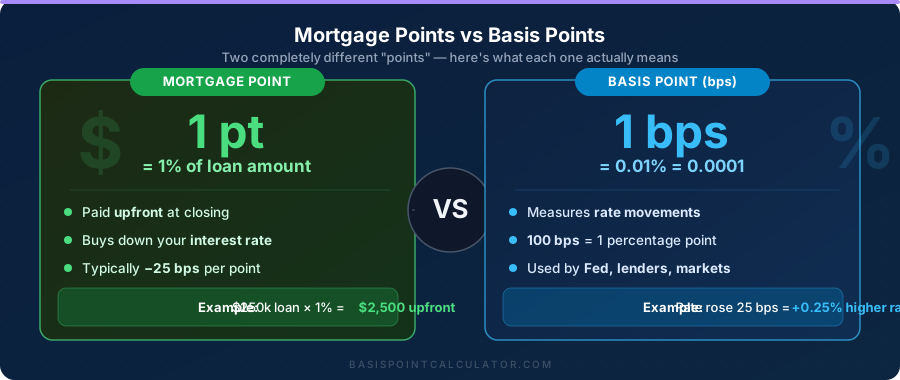
In casual conversation, “25 points” is ambiguous. Always specify: “25 basis points” or “25 percentage points.” In mortgage contexts, “points” often refers to discount points (each equal to 1% of the loan amount), which is a third, entirely different usage.
Mistake 3: Applying percentage change logic to basis points
If a rate moves from 2.00% to 3.00%, that is:
- A change of 1 percentage point
- A change of 100 basis points
- A 50% relative increase in the rate itself
These are three different ways to describe the same move. Don’t mix them up in the same calculation.
Quick Reference: Basis Points vs Percentage Points
| Scenario | In Basis Points | In Percentage Points |
|---|---|---|
| Fed standard rate hike | 25 bps | 0.25 pp |
| Aggressive Fed hike | 75 bps | 0.75 pp |
| Full 1% rate increase | 100 bps | 1.00 pp |
| Mortgage rate negotiation | 50 bps off | 0.50 pp off |
| Investment fund fee | 75 bps/year | 0.75 pp/year |
| Credit spread tightening | 20 bps | 0.20 pp |
Frequently Asked Questions
Is 1 basis point the same as 1 percentage point?
No. 1 basis point equals 0.01 percentage points. It takes 100 basis points to equal 1 percentage point. This is the most important distinction to remember.
When should I use basis points vs percentage points?
Use basis points when discussing interest rates, yields, loan spreads, or financial instrument pricing — especially for changes smaller than 1%. Use percentage points in broader economic discussions, statistical reporting, or when the audience is non-financial.
Why do financial professionals prefer basis points?
Basis points remove ambiguity. When someone says a rate “changed by 1%,” it’s unclear whether they mean 1 percentage point or a 1% relative increase. Basis points always refer to an absolute change of 0.01%, making communication precise and unambiguous in contracts and financial reporting.
How do I convert 50 basis points to a percentage?
Divide by 100: 50 ÷ 100 = 0.50%. So 50 basis points equals 0.50 percentage points.
What is 1 percentage point in basis points?
Multiply by 100: 1 × 100 = 100 basis points. One full percentage point equals exactly 100 basis points.
Can basis points be negative?
Yes. A rate decrease of 25 bps means the rate dropped by 0.25 percentage points. Negative basis points are used to describe rate cuts, yield compression, and spread tightening.
What’s the difference between a basis point and a pip?
In foreign exchange (forex) markets, a pip is typically 0.0001 of the quoted exchange rate — which is also 1 basis point in the price of a currency pair. While often used interchangeably in forex contexts, “pip” is specific to currency trading while “basis point” applies across all fixed-income and lending markets.
Final Thoughts
The difference between basis points and percentage points comes down to scale: 1 basis point = 0.01 percentage points. While that gap sounds small, it has enormous real-world implications. A 50-basis-point drop in your mortgage rate can save you nearly $1,200 per year. A 50-percentage-point drop is simply not a real-world scenario.
Understanding which unit is being used — and converting accurately between them — is one of the most practical financial literacy skills you can have, whether you’re negotiating a mortgage, following Fed policy, or evaluating investment fees.
Use our free Basis Point Calculator to instantly convert between basis points, percentage points, and decimals — no math required.
Disclaimer: This article is for educational purposes only and does not constitute financial advice. Always consult a qualified financial professional before making borrowing or investment decisions.