Convert BPS to Percentage: The One Formula You Need
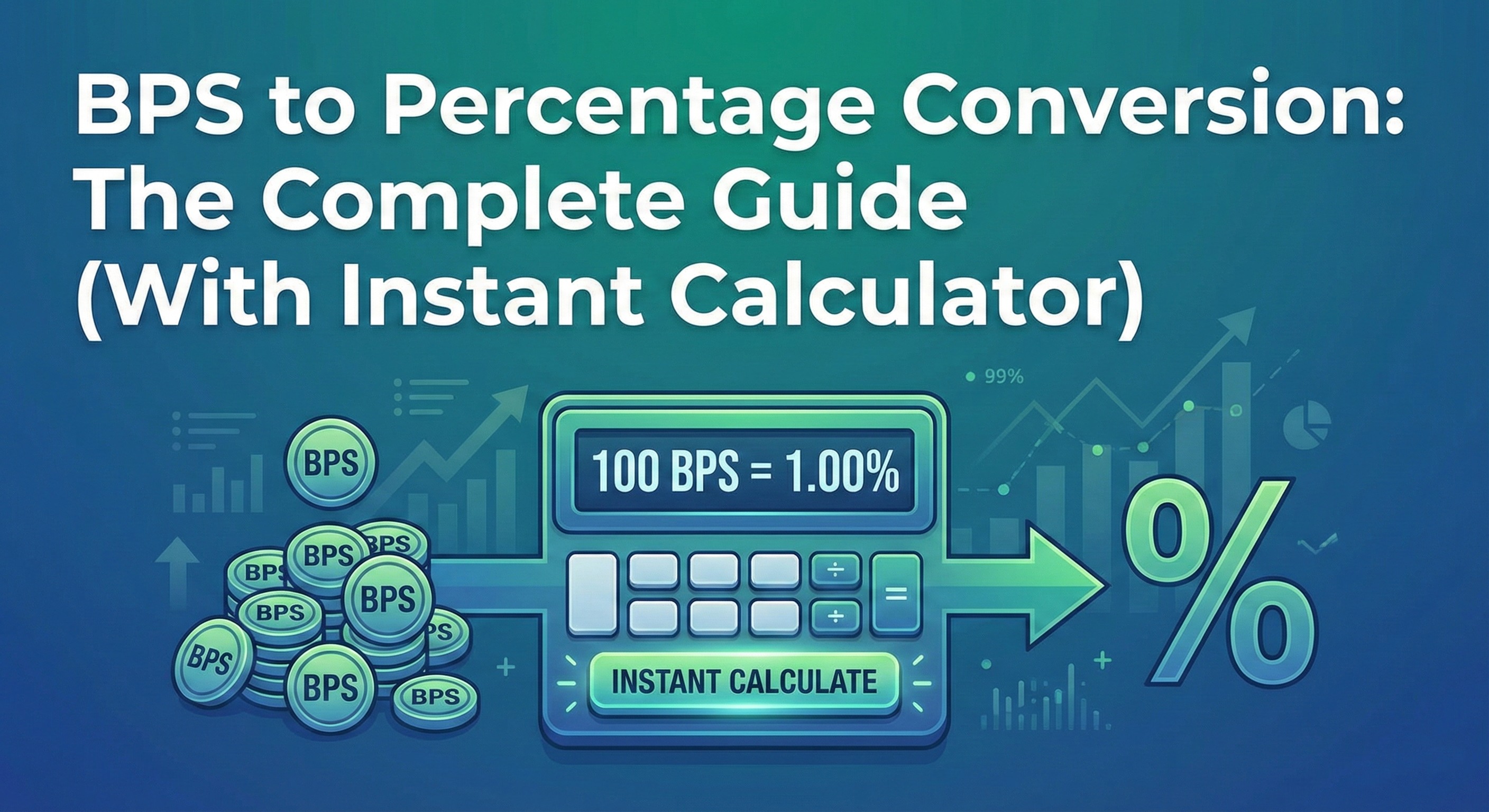
Converting basis points to a percentage requires just one simple operation:
Percentage = Basis Points ÷ 100
That’s it. No complex formulas. No spreadsheet needed.
Examples:
- 25 bps ÷ 100 = 0.25%
- 50 bps ÷ 100 = 0.50%
- 100 bps ÷ 100 = 1.00%
- 300 bps ÷ 100 = 3.00%
And going the other direction (percentage to basis points):
Basis Points = Percentage × 100
Complete BPS to Percentage Conversion Chart
Use this reference table to convert any common basis point value instantly.
Low-Range BPS (1–100 bps)
| Basis Points | Percentage | Decimal |
|---|---|---|
| 1 bps | 0.01% | 0.0001 |
| 2 bps | 0.02% | 0.0002 |
| 3 bps | 0.03% | 0.0003 |
| 5 bps | 0.05% | 0.0005 |
| 10 bps | 0.10% | 0.001 |
| 15 bps | 0.15% | 0.0015 |
| 20 bps | 0.20% | 0.002 |
| 25 bps | 0.25% | 0.0025 |
| 30 bps | 0.30% | 0.003 |
| 40 bps | 0.40% | 0.004 |
| 50 bps | 0.50% | 0.005 |
| 60 bps | 0.60% | 0.006 |
| 75 bps | 0.75% | 0.0075 |
| 80 bps | 0.80% | 0.008 |
| 90 bps | 0.90% | 0.009 |
| 100 bps | 1.00% | 0.01 |
Mid-Range BPS (100–1,000 bps)
| Basis Points | Percentage | Decimal |
|---|---|---|
| 100 bps | 1.00% | 0.01 |
| 125 bps | 1.25% | 0.0125 |
| 150 bps | 1.50% | 0.015 |
| 175 bps | 1.75% | 0.0175 |
| 200 bps | 2.00% | 0.02 |
| 250 bps | 2.50% | 0.025 |
| 300 bps | 3.00% | 0.03 |
| 350 bps | 3.50% | 0.035 |
| 400 bps | 4.00% | 0.04 |
| 450 bps | 4.50% | 0.045 |
| 500 bps | 5.00% | 0.05 |
| 600 bps | 6.00% | 0.06 |
| 700 bps | 7.00% | 0.07 |
| 750 bps | 7.50% | 0.075 |
| 800 bps | 8.00% | 0.08 |
| 1000 bps | 10.00% | 0.10 |
High-Range BPS (1,000–10,000 bps)
| Basis Points | Percentage | Decimal |
|---|---|---|
| 1,000 bps | 10.00% | 0.10 |
| 1,500 bps | 15.00% | 0.15 |
| 2,000 bps | 20.00% | 0.20 |
| 2,500 bps | 25.00% | 0.25 |
| 5,000 bps | 50.00% | 0.50 |
| 10,000 bps | 100.00% | 1.00 |
Step-by-Step: How to Convert BPS to Percentage (Worked Examples)
Example 1: Fed Rate Hike Announcement
You hear the Federal Reserve hiked rates by 75 basis points. What percentage is that?
Step 1: Apply the formula: 75 ÷ 100 Answer: 0.75%
The Fed raised rates by three-quarters of a percentage point.
Example 2: Investment Fund Expense Ratio
A mutual fund charges 85 basis points in annual fees. What percentage of your investment does that represent?
Step 1: 85 ÷ 100 Answer: 0.85%
If you have $100,000 invested, you pay $850/year in fees.
Example 3: Bond Yield Spread
A corporate bond yields 350 basis points over the risk-free Treasury rate. The 10-year Treasury is at 4.20%. What is the corporate bond yield?
Step 1: Convert 350 bps: 350 ÷ 100 = 3.50% Step 2: Add to Treasury: 4.20% + 3.50% = 7.70%
The corporate bond yields 7.70%.
Example 4: Mortgage Rate Change
You locked your mortgage at 6.50% three months ago. Today the same loan is offered at 7.25%. How many basis points did rates rise?
Step 1: Find the difference: 7.25% − 6.50% = 0.75% Step 2: Convert to BPS: 0.75% × 100 = 75 basis points
Rates rose 75 bps. You locked at the right time.
Example 5: Credit Card APR Comparison
Card A charges 1,999 bps APR. Card B charges 2,199 bps APR. What’s the percentage difference?
Card A: 1,999 ÷ 100 = 19.99% Card B: 2,199 ÷ 100 = 21.99% Difference: 200 bps = 2.00%
BPS to Decimal Conversion (For Excel & Financial Formulas)
Many financial calculations require decimal form, not percentage form. The conversion is one extra step:
Decimal = Basis Points ÷ 10,000
| BPS | Percentage | Decimal |
|---|---|---|
| 1 | 0.01% | 0.0001 |
| 25 | 0.25% | 0.0025 |
| 50 | 0.50% | 0.005 |
| 100 | 1.00% | 0.01 |
| 250 | 2.50% | 0.025 |
| 500 | 5.00% | 0.05 |
Excel formula: =A1/10000 (where A1 contains the basis point value)
Converting BPS in Different Financial Contexts
BPS in Bond Markets
Bond traders express yield spreads in basis points constantly. A “spread of 150 bps” over Treasuries means the bond yields 1.50% more than the benchmark. Widening spreads (in bps) signal rising risk; tightening spreads signal improving credit quality.
BPS in Forex Markets
Currency traders sometimes use pips rather than basis points, but in institutional forex, rate differentials between two countries are expressed in basis points. A 200 bps interest rate differential between two central banks is a major driver of currency flows.
BPS in Equity Markets
Stock indices can move by basis points too. A 50-point move in the S&P 500 from 5,000 to 5,050 is a move of 100 basis points (1.00%).
BPS in Loan Origination Fees
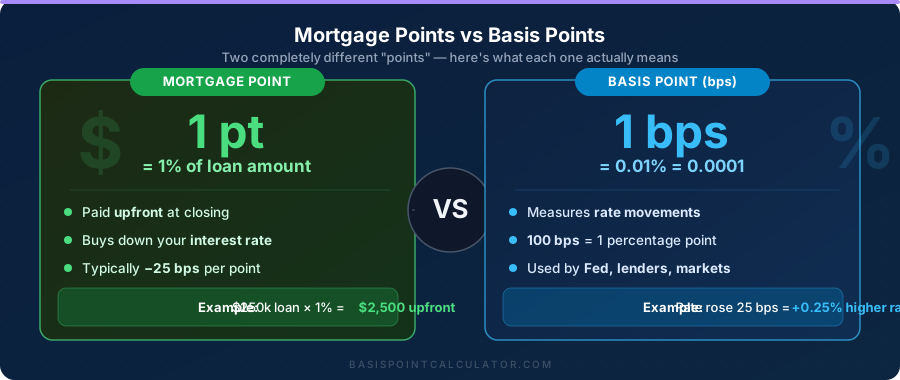
Mortgage and loan origination fees are often quoted in basis points. A “1-point origination fee” = 100 bps = 1% of the loan value. On a $500,000 loan, that’s $5,000.
Common BPS Conversion Mistakes to Avoid
Mistake 1: Confusing “percent” with “percentage points” If a rate goes from 4% to 5%, it increased by 1 percentage point (100 bps). It did NOT increase by 1 percent (which would be only 4 bps, since 1% of 4% = 0.04%).
Mistake 2: Dividing by 1,000 instead of 100 A common error. Always divide basis points by 100 to get percentage, or by 10,000 to get decimal. Never divide by 1,000.
Mistake 3: Forgetting to add the spread to the base rate When a bond has a “spread of 200 bps over the benchmark,” you must add 2.00% to the benchmark rate — not treat the 200 bps as the final rate.
When Should You Use a BPS Calculator vs Manual Math?
Do it manually when:
- You’re converting a single, round number (100 bps, 50 bps)
- You just need a quick sanity check
- You’re explaining the concept to someone
Use a calculator when:
- You’re working with unusual numbers like 137.5 bps
- You need to compare multiple rates simultaneously
- You’re calculating the difference between two rates
- You’re working on a financial model or presentation
Our free BPS to percentage calculator handles all of these instantly with no setup required.
Frequently Asked Questions
How many basis points is 0.5%? 0.5% × 100 = 50 basis points.
How many basis points is 0.25%? 0.25% × 100 = 25 basis points (a quarter-point).
Is 100 basis points equal to 1%? Yes. 100 bps ÷ 100 = 1.00%. This is the fundamental relationship.
What is 1000 basis points as a percentage? 1,000 ÷ 100 = 10.00%.
What does 10 bps mean? 10 basis points = 0.10%, or one-tenth of one percent.
How do I convert bps to decimal in Excel?
Use the formula =A1/10000 where A1 is your basis point cell.
Can basis points be negative? Yes. A rate decrease of 25 bps = −0.25%. You’ll see negative bps used when rates fall or spreads tighten.
Summary: BPS to Percentage at a Glance
| To Convert | Formula | Example |
|---|---|---|
| BPS → Percentage | BPS ÷ 100 | 75 bps → 0.75% |
| Percentage → BPS | % × 100 | 1.5% → 150 bps |
| BPS → Decimal | BPS ÷ 10,000 | 50 bps → 0.005 |
| Decimal → BPS | Decimal × 10,000 | 0.0025 → 25 bps |
Whether you’re analyzing Fed rate decisions, comparing mortgage quotes, evaluating bond yields, or checking fund fees — mastering the BPS-to-percentage conversion is a foundational finance skill.
→ Skip the math and convert any BPS value instantly with our free calculator.